

Find more articles on this and other psychiatry and CNS topics:
The Journal of Clinical Psychiatry
The Primary Care Companion for CNS Disorders
The tendency for patients with bipolar II disorder to present with depressive symptoms rather than hypomanic symptoms can lead to a misdiagnosis of unipolar depression. These patients are often treated with antidepressants, which may be inappropriate for patients with bipolar II disorder due to the risk of inducing manic switching or rapid cycling. Misdiagnosis and mistreatment or nontreatment can lead to substantial psychosocial dysfunction, which may be best addressed in the context of psychotherapy. Psychotherapy in conjunction with pharmacotherapy has been shown to be an effective treatment for patients with bipolar II disorder, but more research is needed to better understand how treatment interventions should be used to optimize symptomatic and functional outcomes.
From the Editors

Are you a healthcare provider?
Add your NPI to personalize your JCP experience.
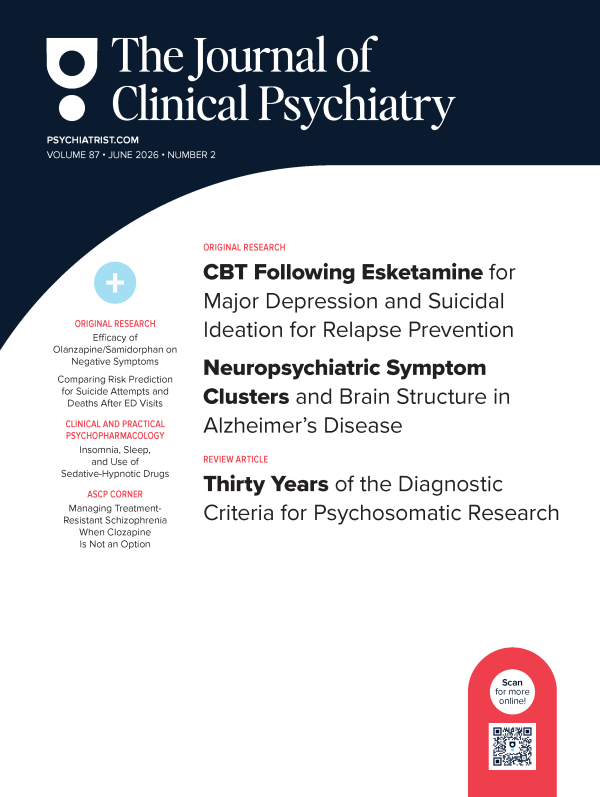
Vol 87 • 2026 • Number 2
Read the Current Issue
Original Research
CBT following Esketamine for Major Depression and Suicidal Ideation for Relapse Prevention: The CBT-ENDURE Randomized Trial
Original Research
Neuropsychiatric Symptom Clusters and Brain Structure in Alzheimer’s Disease
Systematic Review
Thirty Years of the Diagnostic Criteria for Psychosomatic Research
Original Research
Efficacy of Olanzapine/Samidorphan on Negative Symptoms
Original Research
Comparing Risk Prediction for Suicide Attempts and Deaths After Emergency Department Visits
Clinical and Practical Psychopharmacology
Insomnia, Sleep, and the Use of Sedative-Hypnotic Drugs: Practical Notes
Learn More About Psychedelics in Psychiatry
Explore the Collection